


Business Meditation: A Practical Guide to Reducing Stress and Growing a Successful Company
Introduction: Why Business Meditation Matters in 2026
It’s 8:47 a.m. on a Tuesday. A VP of People Operations stares at 43 unread Slack messages, two conflicting Zoom invites, and a resignation letter that landed in her inbox overnight. She hasn’t had a full breath since waking up. Then she remembers the 30-minute meditation session her team piloted last month. She closes her laptop lid, sits quietly, takes three deep breaths, and returns to her screen with a present mind. That session didn’t solve her problems. It gave her the mindset to solve them herself.
Business meditation is the targeted use of mindfulness and meditation practice to support business success through sharper problem solving, stronger emotional intelligence, and sustainable performance under pressure. It’s not about inner peace for its own sake. It’s about building the mental infrastructure that modern leadership demands.
The numbers make the urgency clear. According to the American Institute of Stress, 83% of U.S. workers suffer from work-related stress. 77% of employees experience burnout at their current job. Companies lose an estimated $300 billion annually due to workplace stress. These aren’t problems a ping-pong table or free snacks will fix. They require a simple daily practice that targets the root cause: how people process pressure.
INSCAPE is the number one provider of live, instructor-led mindfulness meditation sessions and programs for companies and professionals. Throughout this guide, you’ll see how meditation can be part of a corporate wellness strategy that delivers measurable results.
Let’s start with why most meditation efforts fail before they begin.
The Problem with Meditation Outside the Workplace
Most professionals know meditation helps. The issue is logistics, not motivation.
Consider the reality of hybrid work in 2026. A marketing director in Toronto commutes ninety minutes on her in-office days, picks up her kids at 5:30, and barely manages dinner before collapsing. A 7 p.m. studio meditation class across town? That’s not realistic. A product manager in London finishes his last Zoom call at 6:15 p.m., then opens his laptop again after his daughter’s bedtime to respond to a Slack thread from the San Francisco team. Weekend meditation workshops compete with laundry, groceries, and the unstructured rest that burned-out professionals desperately need.
Apps like the Headspace app and similar tools help, but they often lack accountability and human connection. Most people open a meditation app three or four times, then forget about it entirely. Without a live instructor and a scheduled time, fitting meditation into life outside work becomes another item on an already impossible to do list.
The solution isn’t asking employees to meditate on their own time. It’s integrating meditation into work hours through live, scheduled sessions that remove logistical barriers and normalize mental health as a key component of business success.
What Is “Business Meditation” and How Is It Different?
Business meditation refers to mindfulness and meditation practices intentionally designed to support leadership, team performance, and healthy company cultures. Meditation practices date back thousands of years, but business meditation adapts these ancient tools for modern corporate environments.
Here’s how meditation for business differs from purely spiritual or general wellness approaches:
- Purpose-driven focus. Sessions target decision-making, emotional regulation, and communication under pressure rather than spiritual growth alone.
- Adapted to real work scenarios. Techniques are designed for difficult negotiations, performance reviews, product launches, and board meetings-not retreat settings.
- Embedded in work routines. Short, practical meditation techniques fit into demanding workdays. Sessions happen between calls, before meetings, or at the start of the day.
- Present moment awareness beyond the cushion. Leaders learn to stay present during email composition, strategic planning sessions, and one-on-ones-not only during formal meditation.
- Measured by business outcomes. Retention rates, engagement scores, sick days, and productivity matter as much as subjective well-being.
- Scalable across teams. Programs serve distributed teams across time zones through live virtual delivery.
Key Benefits of Meditation for Business Owners and Leaders
Research shows that consistent meditation practice can improve focus, reduce impulsive reactions, and strengthen the prefrontal cortex, the brain area responsible for planning and self-control. For any business owner or small business owner navigating high-stakes decisions daily, these aren’t abstract perks-they’re operational advantages.
Here are the core benefits of meditation for leaders:
- Enhanced emotional intelligence. Meditation enhances emotional intelligence by strengthening brain areas for regulation, helping leaders read rooms, manage conflict, and respond thoughtfully instead of reacting.
- Sharper problem solving. Quieting mental noise creates space for non-obvious solutions. Leaders report significant improvements in strategic thinking after sustained practice.
- Increased resilience during crises. Aetna found that employees who meditated saw stress drop 28% and productivity gains of roughly $3,000 per employee annually-about 62 minutes of recaptured productivity per week. That resilience helps leaders stay calm and adaptable in challenging situations.
- Better work life balance. Regular meditation practice creates natural transitions between work and personal time, reducing the bleed of work related stress into evenings and weekends.
- Clearer communication. Leaders who practice meditation listen more carefully, give better feedback, and build improved relationships across their teams.
- Long-term strategic thinking. A 2025 RCT with business students found that meditation training increased cooperative decision-making and reduced short-term thinking.
Companies with meditation programs report higher employee engagement scores. These benefits compound over months of consistent practice-they don’t appear after a single session.

How Meditation Reduces Stress and Prevents Burnout
When you feel stressed, your body floods with cortisol, your heart rate spikes, and your prefrontal cortex-the part of the brain responsible for clear thinking-goes partially offline. This is the fight-or-flight response, and it’s useful when facing a physical threat but counterproductive when facing an inbox. Meditation activates the body’s relaxation response to reverse this cycle. It lowers cortisol levels, reducing stress hormones and restoring cognitive function.
The data is striking. Meditation can lead to a 30% decrease in stress-related symptoms. Mindfulness meditation helps manage stress and mental overload by interrupting the rumination loops that keep professionals awake at 2 a.m. Some research even suggests that a focused meditation session can recharge you more than an hour of sleep.
Here’s how stress reduction works in practice:
- Before a high-stakes pitch. A sales leader uses box breathing-four counts in, four counts hold, four counts out, four counts hold-for two minutes before walking into a Q4 presentation. Box breathing is effective for managing pressure before important situations and provides a quick mental reset.
- After a difficult conversation. An HR director pauses for five deep breaths before responding to a termination email, shifting from reactive to deliberate.
- Mid-afternoon energy crash. Instead of another coffee, a product manager takes a 15-minute guided session to reset focus and lower stress levels.
- End-of-day transition. A founder practices three minutes of breathing before leaving the office, creating a boundary between less stress at home and the intensity of running their own business.
The downstream effects are measurable: better sleep quality, fewer headaches, lower blood pressure, and fewer sick days. Stress relief isn’t a luxury-it’s a business investment in consistent performance.
Strengthening Focus, Creativity, and Problem Solving
Constant notifications, multitasking, and back-to-back video calls erode your ability to do deep work. Meditation enhances focus and attention in a distraction-filled world by training your brain to sustain concentration on one task at a time.
Focused attention meditation trains sustained attention by asking you to hold awareness on a single point-your breath, a sound, or a physical sensation-and gently return whenever your mind wanders. Focused attention meditation helps improve productivity because this same skill transfers directly to work: reading a contract without drifting, listening to a customer call without checking email, or analyzing data without context-switching.
Just 10 minutes of daily meditation can boost productivity. Across a team, meditation can boost overall employee productivity by 10 minutes daily per person-which compounds into hours of recaptured output each week.
- Problem solving under pressure. A 2025 lab experiment found that participants who meditated before high-cognitive-load tasks made more consistent, less impulsive decisions. Quieting mental chatter creates space for creative solutions to complex business challenges.
- Creativity in design sprints. A product team opens each sprint with a 5-minute present moment practice, allowing designers to arrive fully present rather than carrying residual stress from the previous meeting.
- Intuition for strategic decisions. A founder notices an insight about market positioning during a 10-minute guided meditation-not by forcing it, but by creating the mental stillness where intuition surfaces.
Meditation enhances focus and attention in distraction-filled environments. In the long run, teams that meditate together think more clearly together.
Enhance Emotional Intelligence for Better Leadership
Emotional intelligence is the capacity to notice, understand, and manage both your own emotions and those of the people around you. Meditation enhances emotional intelligence by improving emotional regulation-the ability to pause between stimulus and response. Mindfulness meditation improves awareness and emotional regulation simultaneously, giving leaders a real-time dashboard of their internal state.
Here’s why this matters in the corporate world:
- Feedback conversations. A manager notices rising frustration during a performance review, takes a brief breath, and asks a clarifying question instead of shutting the employee down. Self awareness transforms reactive managers into better leaders.
- Conflict resolution. High EQ leaders communicate effectively and resolve conflicts well. Meditation strengthens brain areas responsible for emotional regulation, making it easier to respond thoughtfully during heated cross-functional debates.
- Compassion across teams. Loving-kindness meditation develops compassion and empathy, which translates into more patient interactions with direct reports, peers, and customers. Meditation fosters empathy and compassion in workplace interactions at every level.
- Navigating layoffs and restructuring. Emotional intelligence helps manage personal and others’ emotions during the hardest moments of leadership-delivering bad news, absorbing team anxiety, and maintaining trust.
- Distributed team dynamics. When you can’t read body language in a Zoom window, heightened emotional awareness-built through mindfulness training-becomes your primary tool for effective communication.
The business outcomes are clear: lower turnover, stronger team building, more psychological safety, and a deeper understanding of what your people actually need.

Team Building and Culture: Meditation as a Shared Practice
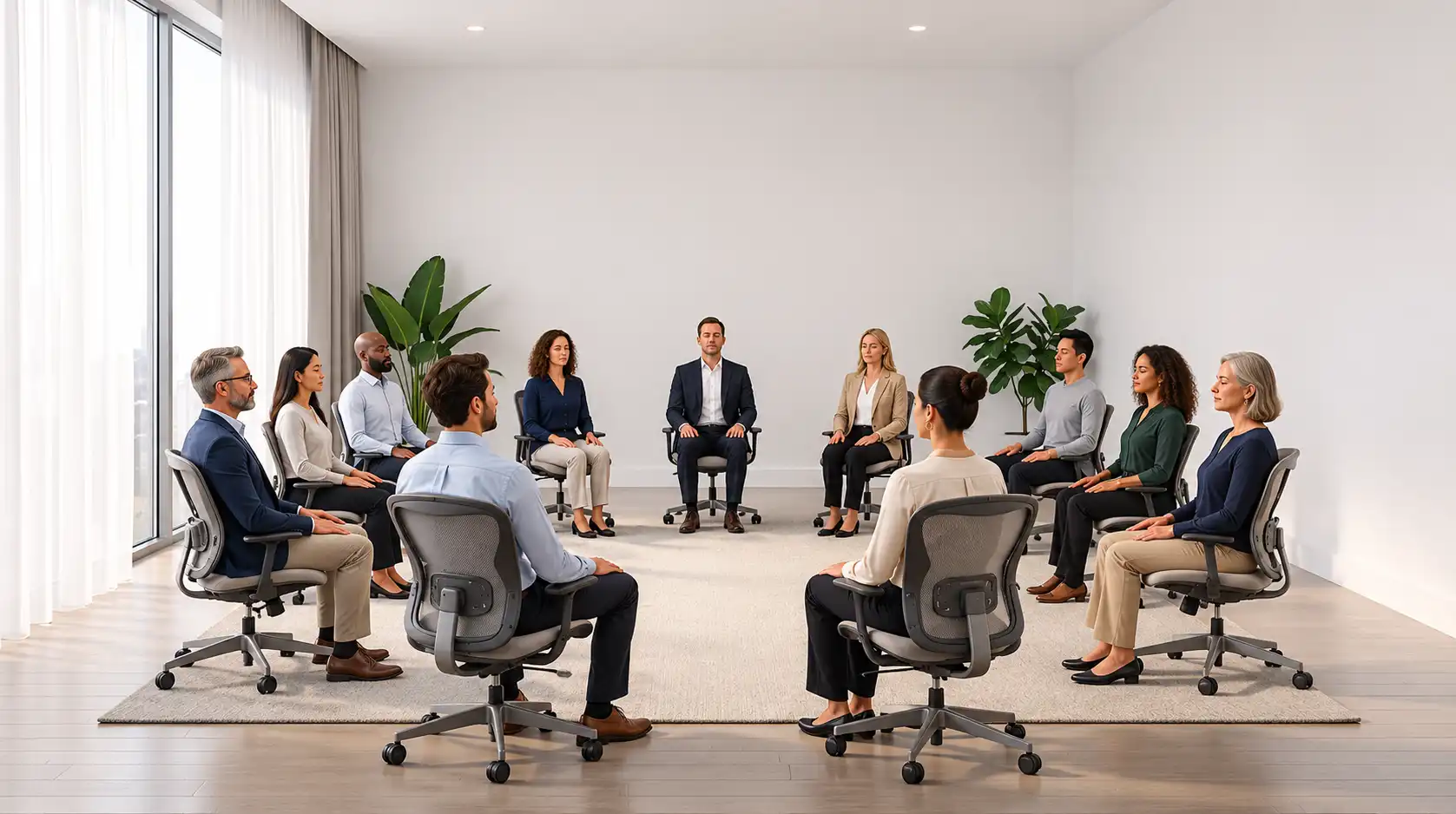
When an intern, a manager, and a former CEO sit quietly together in the same guided meditation session, something shifts. Hierarchy flattens. Shared vulnerability builds trust faster than any offsite exercise.
Meditation for business directly supports team building outcomes:
- Shared rituals. A distributed engineering team opens weekly standups with a 3-minute breathing exercise. Over time, this becomes a ritual that signals “we’re present, we’re together.”
- Cross-department empathy. When sales and product teams practice meditation together, they develop patience for each other’s constraints and perspectives-leading to smoother collaboration and fewer turf wars.
- Psychological safety. Research supports workplace mindfulness interventions for improving employee well being. Teams that meditate together report feeling safer to disagree, ask questions, and admit mistakes.
- Remote collaboration. Virtual mindfulness meditation for businesses bridges the isolation of remote work by creating a shared experience that doesn’t depend on physical proximity.
- Consistent culture signals. Companies with meditation programs report higher employee engagement scores because the programs signal that leadership genuinely cares about employee well being.
INSCAPE’s live online sessions make it easy to institutionalize these rituals across offices, time zones, and team sizes. Visit INSCAPE’s corporate mindfulness programs to explore how this works in practice.
Designing a Simple Daily Practice at Work
You don’t need a meditation cushion, incense, or thirty minutes of silence. You need consistency, intention, and brief windows of attention. Meditation can be practiced in as little as three minutes.
Here’s a practical blueprint for any professional:
- 9:05 a.m. – Centering. After logging in, close your eyes for three minutes. Focus on your breath. This is your transition from “commute mode” to “work mode.”
- Before your hardest task. Take five minutes of guided meditation before the most important item on your calendar. Visualization meditation builds confidence and prepares for challenges like presentations or negotiations.
- Mid-day reset. Body scan meditation encourages relaxation by guiding awareness through your body from head to feet. Body scan meditation also increases awareness of physical tension you’ve been ignoring since morning.
- Walking break. Walking meditation combines gentle movement with mindful awareness. Take a 5-minute walk without your phone, noticing each step.
- Pre-meeting pause. While waiting for a Zoom meeting to load, feel your feet on the floor and take three slow breaths. Stay present instead of mentally rehearsing your talking points.
- 5:55 p.m. – Reflection. Before closing your laptop, spend two minutes noticing how you feel. Mindfulness meditation increases awareness of emotional reactions, helping you leave work stress at work.
Practice meditation doesn’t require special equipment. It requires showing up for yourself for a few minutes at predictable points in your daily routine.
Regular meditation-even short-makes a big difference over weeks and months.
Guided Meditation vs. Solo Practice: What Works Best for Business?
Both guided meditation and solo practice have a place in business. The question is which to use when.
- Guided meditation offers a structured way for relaxation and targeted focus. It reduces decision fatigue because someone else leads the session. Themes can be tailored-stress relief before a product launch, clarity for strategic planning, or resetting after conflict.
- Solo practice builds independence. Over time, professionals who’ve attended regular meditation classes develop the skill to take three deep breaths, drop into a present moment awareness, and reset on their own between meetings.
- Best for beginners: guided. New meditators benefit from live instruction, real-time Q&A, and the accountability of a scheduled session. Meditation apps vs. virtual meditation classes explains why live interaction outperforms passive recordings.
- Best for experienced practitioners: a blend. Many leaders combine weekly guided sessions with daily solo check-ins, using the skills they’ve learned to stay present during their regular workday.
INSCAPE’s live, instructor-led sessions provide real-time interaction and tailored themes for specific teams. Explore corporate mindfulness programs for an overview, or custom corporate mindfulness programs for fully tailored solutions.
Bringing Meditation Into Your Workplace: Practical Steps
If you’re an HR leader or executive ready to move from interest to implementation, here’s a clear path:
- Assess current stress levels. Run an anonymous survey using the Perceived Stress Scale. Establish a baseline so you can measure change later. Remember: 83% of U.S. workers suffer from work-related stress, so your team likely isn’t the exception.
- Secure leadership buy-in. Share the data: meditation programs can save U.S. businesses an estimated $300 billion annually in reduced absenteeism and healthcare costs. Meditation can reduce stress-related symptoms by 30%. Frame it as a performance tool, not a perk.
- Pilot a 3-month program. Start with weekly or twice-weekly live sessions. The Judge Group ran a six-week blended mindfulness program and 85% of participants reported reduced stress while 64% reported improved concentration.
- Set up logistics. Book a quiet room or create a recurring virtual link. Pick a consistent time (e.g., Tuesdays at 12:30 p.m. ET). Send a simple Slack or email invite.
- Gather feedback and measure. Use pre/post surveys on stress and focus, track participation rates, monitor sick days, and collect qualitative stories. Companies that measure ROI on wellness programs report positive returns 95% of the time.
- Scale what works. Expand from a pilot into ongoing daily or weekly mindfulness programs, leadership cohorts, or targeted programs for high-stress departments.
Ready to start? Book a 30-, 45-, or 60-minute Introduction to Mindfulness Meditation session with INSCAPE.
Custom Corporate Programs with INSCAPE
Generic apps deliver generic results. A pre-recorded session about “finding your center” doesn’t help a finance team navigating year-end close or a co-founder preparing for a Series B pitch. That’s why customized corporate meditation programs exist.
INSCAPE co-designs programs with HR and leadership teams, aligning sessions to company values, key business seasons, and specific themes like emotional intelligence, resilience, creativity, or team building. Sessions are facilitated by experienced instructors who understand corporate environments-not retreat leaders reading from a script.
Here’s what a custom engagement looks like:
- Pilot phase. A 3-month program with weekly live virtual sessions tailored to your team’s biggest stressors and goals.
- Ongoing practice. Daily or weekly meditation classes available to all employees, with themes rotating based on business cycles (e.g., stress management during Q4, creativity exercises during product development sprints).
- Leadership cohorts. Executive meditation classes designed for senior leaders navigating high-stakes decisions, organizational change, or rapid scaling.
- Targeted interventions. Programs for high-stress departments-customer support, sales, or engineering teams approaching deadlines.
Visit INSCAPE’s corporate mindfulness programs for general overviews or custom corporate mindfulness programs to start designing a solution built for your organization.
Conclusion: Making Meditation a Strategic Business Advantage
Meditation for business isn’t a wellness trend. It’s an operational system that enhances emotional intelligence, sharpens problem solving, and builds the resilience that modern companies need to grow sustainably. Meditation helps leaders make better decisions, teams communicate with less friction, and organizations retain talent in a market where employee well being determines who stays and who leaves.
A simple daily practice integrated into work hours can significantly reduce stress and support sustainable business success for founders, managers, and entire teams. You don’t need to overhaul your culture overnight. You need to start.
Take one immediate step: close your eyes right now, take three slow breaths, and notice how you feel. Then take one strategic step: book a virtual mindfulness meditation class with INSCAPE for your team and experience the difference that live, instructor-led meditation makes.
Explore INSCAPE’s full suite of corporate mindfulness programs and start building meditation into your company’s operating system today.
If you are interested in meditation for your employees, contact INSCAPE or call us at (888) 377-7761.